
Now live: WhatsApp Consent Collection


3.3 billion people open WhatsApp every month, and for brands selling into the UK, Europe, and LATAM, it’s the channel customers actually want to buy and hear from you on. The brands running it are reporting higher open rates, click-throughs, and revenue-per-send up to 2X higher than SMS.
So it’s no surprise that the ability to collect WhatsApp consent at checkout has been the single most requested feature from our customers this year.
Today, we’re excited to bring it live. WhatsApp Consent Collection is now available through Dataships.
WhatsApp is exploding, but list growth isn’t keeping pace
Klaviyo shipped native WhatsApp sending in late 2025, and dozens of other WhatsApp-specific sending tools have been on the market for some time. So the infrastructure to message WhatsApp subscribers already exists. But surprisingly, the infrastructure to grow WhatsApp lists at the checkout is very underdeveloped.
Collecting WhatsApp consent at checkout is now possible, including natively. But basic capture and optimized, compliant collection are two very different things. As a result, brands have either gone without or relied on workarounds that carry real risk:
- Bundling WhatsApp into the SMS opt-in, where the shopper never explicitly consents to WhatsApp and the audit trail can’t tell the two apart. In markets like the UK, Ireland, and the Netherlands, WhatsApp counts as “electronic mail” under ePrivacy rules, so this approach won’t hold up.
- Treating SMS subscribers as WhatsApp subscribers, even though an SMS opt-in is not WhatsApp consent.
- Falling back on pop-ups, forms, and QR codes, which convert at a fraction of checkout, collect consent outside the purchase moment, and leave compliance entirely on the merchant.
Those workarounds produce the same outcome: WhatsApp lists that grow slowly, leave revenue on the table, or worse — create real compliance risk exposure.
Checkout is where the consent magic happens
Checkout is the highest-intent moment in the shopper journey. The customer has their phone out, they’re already transacting, and they’re choosing what channels they’d like to hear from you on. It’s also where privacy law gives brands the most room to work: because the customer is actively sharing their data as part of a purchase, the rules around how you collect consent are often more favorable than anywhere else on your site.
That makes checkout make-or-break for both compliance and growth. Get it right and you collect high-quality opt-ins that drive up customer lifetime value and keep you out of legal trouble. Get it wrong and you sacrifice one or the other. It’s the same principle that’s made our platform so effective for email and SMS, now applied to WhatsApp.
How it works
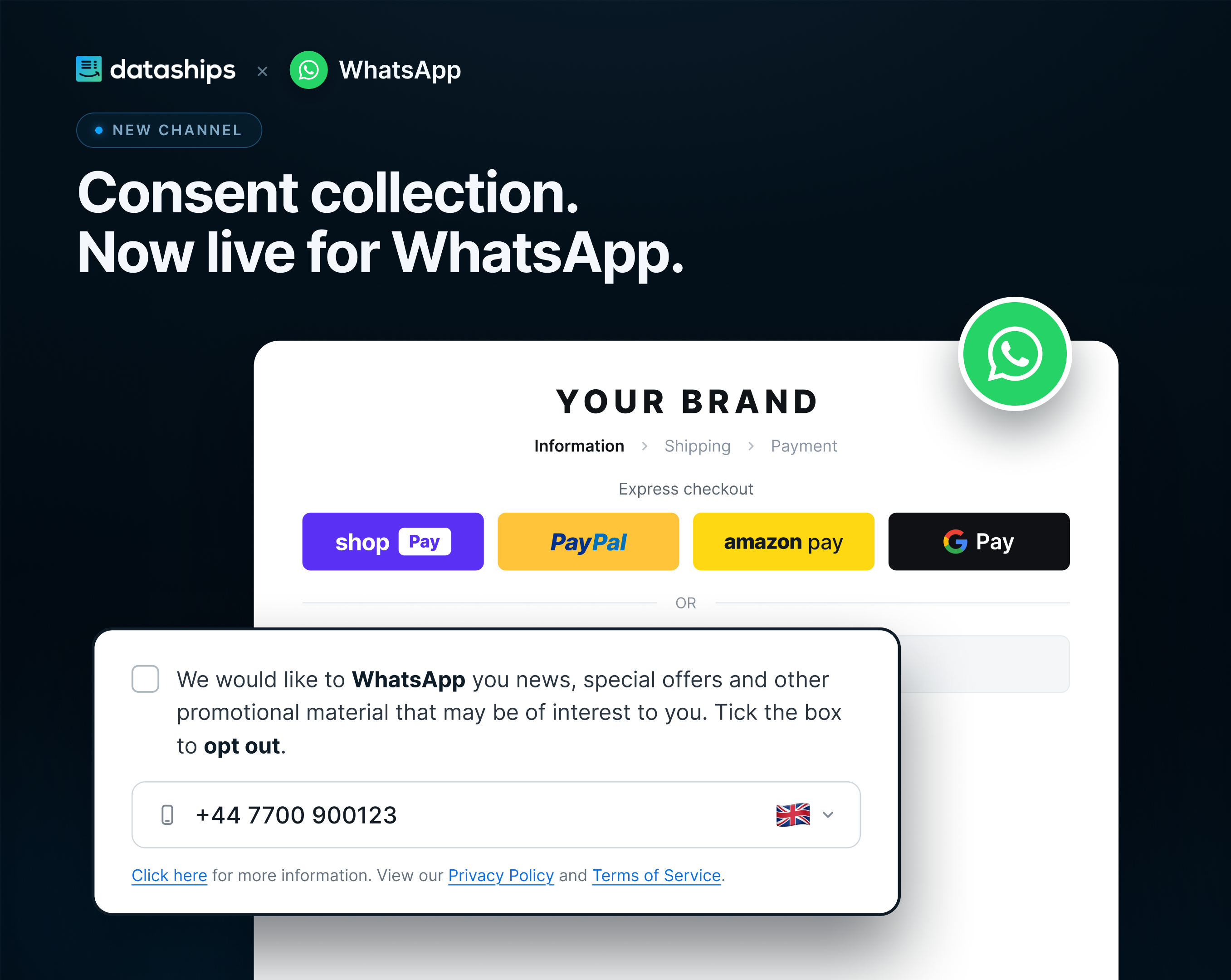
WhatsApp consent is collected at checkout through a single phone-based block. When a shopper checks out, they see a separate, clearly labeled opt-in for each eligible channel they haven’t already subscribed to.
You don’t need SMS enabled to use it. WhatsApp runs as its own independent channel: turn it on by itself, or let it sit alongside SMS in the same phone block. If you collect both, the shopper sees one combined block with a distinct opt-in mechanism for each, so every consent stays explicit and legally separate.
From there:
- Jurisdiction-specific rules apply automatically. Dataships determines the right consent type for each market in real time — opt-in or opt-out, single or double — with no manual configuration per country.
- Already-consented channels drop away. If a shopper has already opted into a channel, its opt-in is hidden so they only see what’s left to subscribe to. A shopper consented across every channel sees nothing at all.
- Every consent is captured and logged: channel, status, timestamp, IP, jurisdiction, the exact wording shown, and the shopper’s action — giving you a defensible audit trail by default.
- Confirmed subscribers sync straight into your Klaviyo WhatsApp list, ready to message.
What you actually get
- The highest-converting way to collect at checkout. Shopify just shipped a basic v1, and everyone else relies on pop-ups and QR codes outside the purchase moment. Dataships is built to maximize opt-ins inside checkout, where intent and success rates are highest.
- High opt-in rates from day one. Up to 75% across the UK and Europe, and 6–10% in double opt-in markets like the US and Germany — at full scale from the very first order.
- Compliance by default. Every opt-in follows the correct rule for its market and channel and carries a complete audit trail, so the list you build is one you can stand behind.
Country-level consent rules breakdown
Like other channels, WhatsApp’s consent requirements change market to market. The rule for WhatsApp in a given country often differs from the rule for the channels beside it. In Canada, SMS can be collected on an opt-out basis while WhatsApp requires an explicit opt-in. In France, it’s reversed.
Dataships applies the correct rule automatically, per country and per channel, and updates it as laws change, so you never configure markets by hand. For example:
- Opt-out is available in countries like Ireland, the UK, and France.
- Single opt-in is required in stricter markets like Italy, Canada, and Australia.
- Double opt-in is required in the strictest markets, like the USA and Germany.
Availability
WhatsApp Consent Collection is available now for Shopify Plus merchants using Klaviyo. You’ll need a WhatsApp Business Account connected to Klaviyo before you start.
Onboarding is a guided flow in the Dataships admin: connect Klaviyo, add your WhatsApp sender details, run the compliance checks, confirm your Klaviyo WhatsApp lists, and install the collection block.
A few things to note:
- Klaviyo is the only integration supported in v1. Support for other platforms is underway — message us if there’s a WhatsApp platform you’d like us to support.
- Meta template approval can take up to 24 hours.
- Any active SMS A/B tests should finish before you onboard WhatsApp.
- Meta does not currently deliver WhatsApp marketing messages to US phone numbers, so this is primarily for brands selling into the UK, Europe, and LATAM. Dataships collects US consent now so you’re ready when that changes.
Compliance is the advantage, not the cost
Dataships is building consent as infrastructure for the future of ecommerce. WhatsApp is the latest channel to receive support on our platform.
The brands that win on WhatsApp won’t be the ones who collected consent fastest. They’ll be the ones who collected it correctly: explicit, separate, and fully documented in every market they sell in. That’s the standard we’ve held for email and SMS, and WhatsApp Consent Collection extends it.
Ready to build a compliant WhatsApp list at checkout? Email your Customer Success Manager or book a demo and we’ll show you your opt-in potential across every market you sell in.



See How Much Revenue You’re Missing Out On
