
How to Increase Opt-In Rates: Build Trust, Convert More Customers



As a brand, one of your main goals is to increase lifetime revenue (LTR) by getting more customers to subscribe to marketing at checkout. But the strategy behind the opt-in form affects the final yes or no.
To increase the opt-in rate, you have to make joining feel like an extension of the purchase experience. Two steps go into making the decision feel easier:
- Clear, engaging messaging and design
- Collecting data with full compliance and trust
In this post, we cover the creative and UX principles that raise opt-in rates at checkout. There’s also a look at showing how to collect data legally and transparently, based on the privacy regulations in different regions. These two pieces work together to show how strong design and clear consent work hand in hand to build trust and increase LTV with stronger opt-in rates.
Key Takeaways 📈 🔥
- Clear, benefit-led copy drives higher opt-ins.
When customers instantly see what they gain (early access, updates, or offers), they’re more likely to subscribe. Copy that sounds human and transparent consistently outperforms legal phrasing at checkout. - Design clarity lifts performance without friction.
Small changes like better placement, spacing, and mobile readability can raise opt-in rates by double digits. Visibility and simplicity beat extra steps or intrusive pop-ups every time. - Compliance builds the trust that makes growth sustainable.
Dataships keeps opt-ins compliant by adapting consent to local privacy laws automatically. That foundation lets creative teams scale and know that every new subscriber is protected and compliant.
Tips on How to Increase Opt-In Rates
Most checkout pages are built to drive the sale, but sometimes lack a way to further the customer relationship.
The most effective tips to increase opt-in rates focus on creating an experience that feels valuable and transparent. Shoppers should understand the benefit immediately.
Think of this brief overview as a checklist for your opt-ins:
✅ Explain exactly what customers get when they opt in.
✅ Keep consent visible and near the action, not hidden below the fold.
✅ Match your brand voice. Plain, friendly, and real.
✅ Show how to unsubscribe and provide privacy transparency.
✅ Make checkboxes readable and mobile-friendly with clean spacing.
✅ Use the consent configuration that is both compliant with the shopper’s region and most likely to result in an opt-in
These small refinements compound fast. When you’re transparent and make the process easy, checkout opt-in rates increase without discounts or disruptive prompts.
For example, Dataships helped On Group reach an 81% opt-in rate with dynamic consent at checkout that adjusted to the customer's location with specific messaging. This messaging was aligned with local privacy laws.
The next section outlines the specific copy and design principles that drive those types of metrics across both email and SMS.
How to Increase Opt-In Rate: Copy and Design Principles
Getting an opt-in from a customer is simply a moment in the conversion process. The way your form looks, reads, and fits into the checkout decides whether customers say yes. Below are practical copy and design tactics that consistently increase opt-in rate for both email and SMS.
Copywriting Principles
Write benefit-first consent copy.
Every line near the opt-in field should make it clear what customers get, and not what you’re asking them to agree to.
Before: “I agree to receive marketing emails.”
After: “Get early access to new drops and exclusive offers.”
You also want to keep copy concise, concrete, and tied to the next immediate benefit.
Writing “Text me tracking updates and limited-time offers” most likely performs better than anything that starts with “Sign up to receive.”
The shift from legal phrasing to benefit phrasing consistently increases checkout opt-ins because it reframes the choice as value-driven, not transactional. The legal precision can be handled by a compliance system behind the scenes. Right now, Dataships has oversight on the opt-in language to meet compliance. However, more customization will soon be an option, and customers will have more control while still keeping the same level of tight compliance.
Keep tone consistent with your brand
If your emails sound a certain way, your opt-in copy should too. You always want to be speaking to your target audience as a brand.
Who are you speaking to? And why?
You know your brand best. That’s the consistency you need, even in your opt-in forms.
To increase opt-in rates, a luxury brand might say, “Be the first to know when collections launch.” A playful CPG brand might use “Want 10% off and first dibs on new flavors?”
Consistency matters because tone signals trust. When the opt-in language matches what customers expect from your brand voice, they’re more confident in checking the box. Inconsistent tone causes a mismatch and lowers conversion, especially on mobile, where shoppers make decisions fast.
Give each channel its own space
Combine channels and opt-in drops. When customers see “Email and SMS updates” in one box, they hesitate. Split permissions by channel with separate checkboxes and short, clear labels.
- Email: “Send me product updates and exclusive offers.”
- SMS: “Text me order updates and time-sensitive deals (max 4 per month).”
Separation satisfies channel-specific consent rules across regions while improving total participation. The goal is to let people opt in confidently. You want them to feel like they have the choice and control.
Design Principles
Place consent where the decision happens
Visibility drives conversion.
Opt-in elements hidden below footers or checkout disclaimers perform worse than those shown right next to contact fields.
Best practice:
- Place the checkbox directly under the email or phone input.
- Ensure it’s visible before the “Complete Purchase” or “Pay Now” button.
- Keep spacing generous because cramped layouts feel like fine print.
If customers have to scroll or search, they skip it. When the choice is in front of them and easy, opt-ins rise without extra incentives.
Design for mobile-first checkout
Most e-commerce checkouts now happen on mobile, where space is limited and clarity is everything. Design opt-in components that are legible, tap-friendly, and unobtrusive.
- Use large touch targets for checkboxes.
- Keep lines under 10 words for easy scanning.
- Use a readable contrast ratio: gray text against white backgrounds kills visibility.
- Remember to design for Dark Mode. FlowCandy created an entire guide and resource for designing in Dark Mode.
Short, high-contrast labels with a single, concrete promise outperform long, dense consent language.
Always preview your checkout on multiple devices before shipping changes.
Reinforce trust in the copy itself
To increase opt-in rate among privacy-conscious customers, build small trust signals into the consent line.
Examples that convert well:
- “No spam. Unsubscribe anytime.”
- “You’ll only get messages about new collections.”
- “Msg & data rates may apply. Max 4 texts per month.”
Customers are more aware of privacy and the amount of content they’re receiving through text and email.
Each line you can build trust preempts anxiety and builds confidence for the sign-up. Pair trust language with a visible privacy link so users can verify details if they choose. You want to communicate the details in plain language.
Use incentives strategically, not automatically
Discounts lift volume, but not all subscribers are worth acquiring. Use incentives that fit your brand identity and product cadence.
For early-stage customers, small monetary rewards work (“Get 10% off your first order”). For loyal customers, access-based rewards perform better (“Unlock early access to limited editions”).
The right incentive signals exclusivity. That’s why Dataships will be introducing features for your brand to have more incentive options. A first-time shopper who hasn’t consented to SMS but has a high cart value could be offered a 10% discount. If the customer has a low cart value, you’ll have the option to hold back on offering the discount.
Here’s a good overall test for figuring out how to increase your opt-in rate:
Would your offer still make sense without a discount? If yes, it’s aligned with brand equity. If not, it’s a temporary patch that inflates unsubscribers later.
Test, track, and repeat
Opt-in rate is a performance metric. Treating it as conversion rate optimization helps you build out the strategy behind the design and any A/B test you might do.
Test one variable at a time:
- Copy phrasing (benefit-first vs. incentive-first)
- Placement (above or below the payment button)
- Visual cues (checkbox color, font weight, spacing)
Monitor results weekly. Small lifts compound. A five-point increase in opt-in rate across checkout can deliver a measurable lifetime value gain without any new ad spend.
How to Increase Opt-In Rate: Privacy Compliance
Privacy Compliance Principles
Privacy regulations aren't obstacles — they're frameworks for optimization. When brands understand what's actually permitted in each market, they unlock higher opt-in rates while staying fully compliant.
The opportunity hiding in plain sight
Most merchants apply the most restrictive interpretation everywhere, leaving massive audience growth on the table. Here's what the current landscape looks like:
Current Performance (Industry Status Quo) - Email
These are the configurations most commonly used in the following regions today, along with their corresponding opt-in rates.
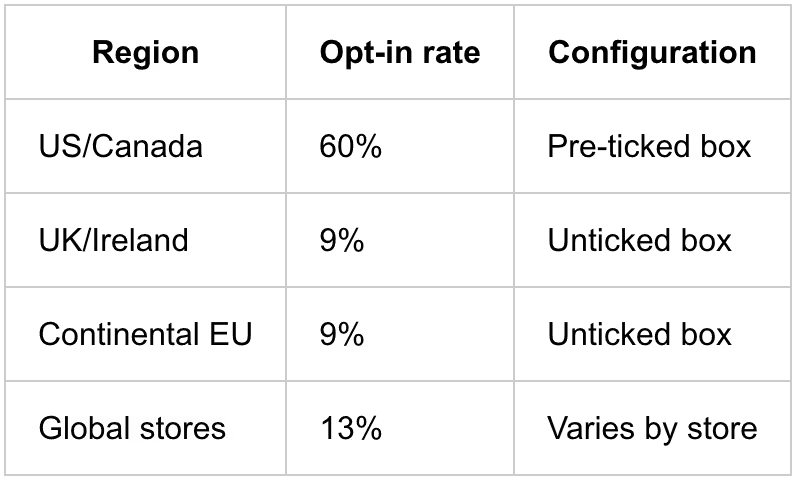
Now compare that to brands optimizing within regional compliance frameworks:
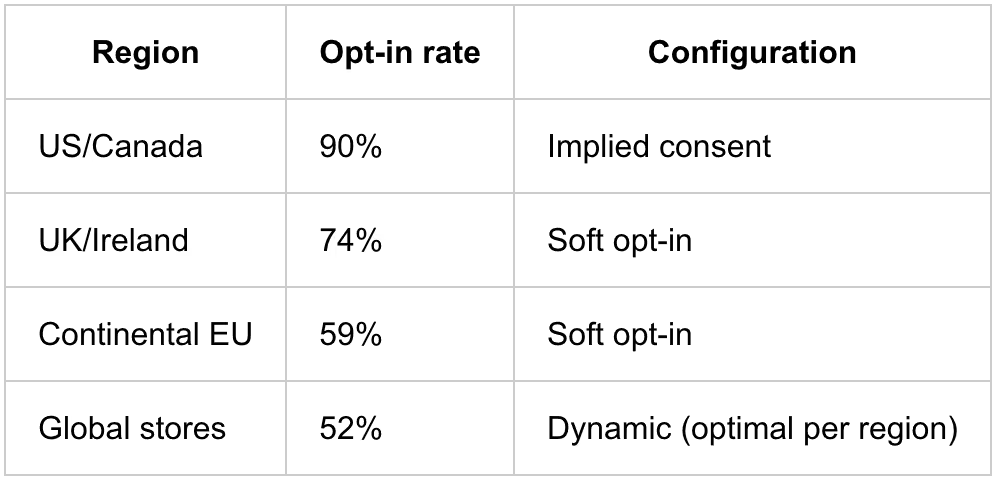
As you can see, one of the biggest levers brands have to increase sign-up rates at checkout is simply to leverage the nuances available to them in every region they sell.
Similarly, on the SMS front, US brands typically see <1% success rates leveraging the typically ‘Reply Y’ double opt-in flow versus a flow that drops the double opt-in verification code down during checkout, which sees 6.6% opt-in rates on average.
What this looks like in practice
Region-specific consent adapts to each shopper's location:
- US/Canada visitors see implied consent language that captures marketing permission without friction, fully compliant with CAN-SPAM and CASL
- UK/EU visitors experience soft opt-in (opt-out) configurations that comply with legitimate interest frameworks under the ePrivacy Directive.
- Other restricted markets, like France, Australia, and Brazil, maintain explicit opt-in to meet their specific implementation requirements
Compliance infrastructure is needed to do this legally
Leveraging these more nuanced interpretations of privacy law may seem as simple as changing language at checkout. However, if a brand values compliance, it will want to ensure all of the following safeguards are in place before doing so:
- Real-time location detection and consent logic across 20+ jurisdictions
- Comprehensive audit logging with timestamps, IP addresses, and legal basis documentation for every consented contact
- Suppression list management to prevent resubscribing opted-out customers
- DNC registry checking for SMS compliance across federal and state levels
- Cross-channel consent coordination to maintain unified customer preferences
Why this matters now
With 19 US states now having distinct privacy laws, Europe escalating enforcement with £17.5M+ GDPR fines, and new regulations launching globally, brands that optimize within compliance frameworks gain a competitive advantage while those ignoring regional nuances face both lost revenue and legal risk.
Privacy compliance isn't about restriction. It's about understanding exactly what each framework permits, then building systems sophisticated enough to optimize within those boundaries at scale. Using these guidelines can help you work within existing limitations to drastically improve your marketing consent rates with customers.
Turn More Customers into Subscribers with FlowCandy and Dataships
You don’t need a full rebuild to increase your brand’s opt-in rate.
Start by testing one variable at a time. That could be copy, placement, or incentive. From there, measure how it affects sign-ups over a week. FlowCandy’s creative team uses this exact process to optimize client checkouts before layering in automated compliance solutions like Dataships.
Want to see how an opt-in strategy could work for your brand?
Schedule a free 30-minute demo with FlowCandy's team of experts to turn more customers into subscribers at checkout.



See How Much Revenue You’re Missing Out On
